


What Problems Can Palletizing Robots Solve
They Reduce Manual Handling At The End Of The Line
Palletizing Robots solve one of the most common problems in manufacturing: repeated manual lifting, carrying, turning, and stacking at the end of the production line. When finished products need to move from packing, rewinding, slitting, inspection, or storage areas onto pallets, manual handling can slow the line and create unstable output during long shifts.
Global factory automation is moving in this direction. The International Federation of Robotics reported 542,000 industrial robot installations in 2024, and the global operational robot stock reached about 4.66 million units. This shows that more factories are using automation to improve handling efficiency and production consistency.
Problems Palletizing Robots Can Solve
| Production Problem | How Palletizing Robots Help | Practical Value |
|---|---|---|
| High labor intensity | Automate repeated lifting and stacking | Reduces pressure on workers |
| Unstable stacking | Follow fixed pallet patterns | Improves pallet shape and transport safety |
| Slow end-of-line flow | Connect packing, conveying, and palletizing | Keeps production moving continuously |
| Product damage | Use controlled gripping and placement | Reduces drops, dents, and deformation |
| Output variation | Repeat the same movement across shifts | Improves order consistency |
| Limited visibility | Work with sensors and control systems | Helps monitor handling status |
Why This Matters In Film Machinery Production
In Film Manufacturing, finished products may include rolls, packed film materials, cartons, or semi-finished products from casting, slitting, rewinding, lamination, Printing, and packing processes. If these products are handled manually, the end of the line can become a bottleneck even when upstream equipment is running well.
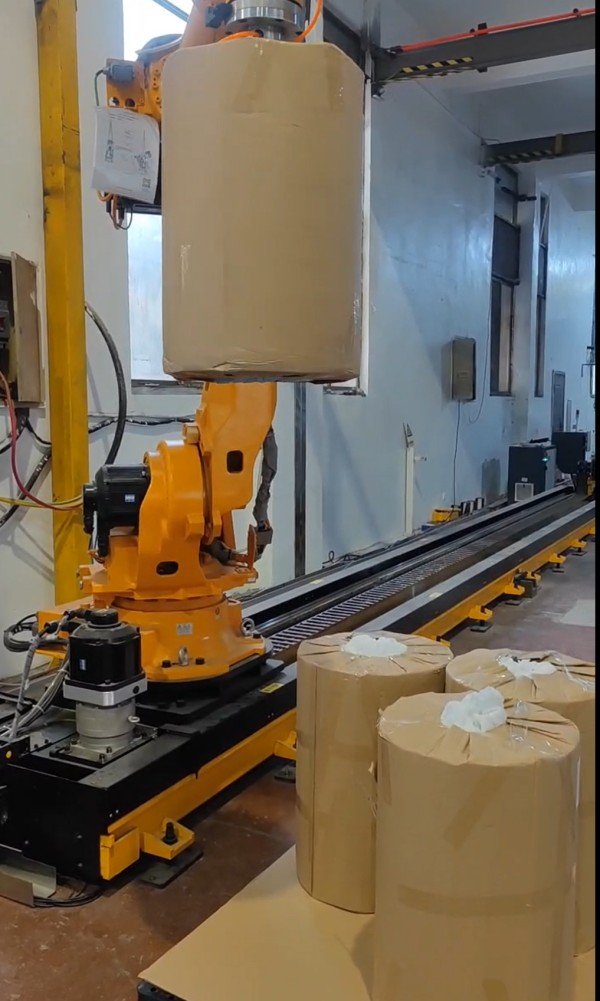
JINGWEI’s automated palletizing equipment is described as a system composed of the main robot arm, end gripper mechanism, conveyor line interface module, intelligent sensor system, servo drive mechanism, electronic control system, and human-machine interface. This means palletizing is not only a robot arm, but a complete handling system designed to connect with factory production flow.
Better Stacking Also Protects Finished Goods
Poor stacking can cause leaning pallets, crushed cartons, unstable rolls, loading delays, and higher damage risk during storage or shipment. A properly designed palletizing robot can place products by size, weight, direction, and pallet pattern. The end-of-arm tooling can also be designed according to the real product shape, which is especially important for film rolls, packed goods, and other items that need careful support.
JINGWEI presents palletizing automation as part of its wider film processing equipment portfolio, including film casting machines, slitting and inspection rewinding machines, printing equipment, lamination systems, silicone coating machines, winding upgrades, and palletizing automation. This integrated experience helps our team consider palletizing together with upstream production instead of treating it as an isolated machine.
Professional Advice For Project Planning
Before choosing Palletizing Robots, buyers should prepare finished product size, weight range, package type, line speed, pallet size, stacking pattern, conveyor height, workshop layout, and future product changes. The robot payload, end gripper, control logic, and safety layout should all match the real production site.
JINGWEI can help review production line data, finished product flow, layout conditions, and automation goals before recommending a palletizing solution. Share your product specifications, output target, and factory layout with our team, and we can help design a practical Palletizing Robot solution for stable production and long-term equipment planning.