


What Is The History Of Robotic Palletizing Systems?
From Manual Stacking To Mechanical Palletizing
Robotic Palletizing Systems developed from the need to make end-of-line handling faster, safer, and more consistent. Before automation, workers manually lifted cartons, bags, rolls, or packaged goods and stacked them on pallets according to fixed patterns. This method worked for small output, but it became slow and physically demanding when production volume increased.
The first mechanical palletizer was built in 1948 as a row-forming system, where products were arranged into rows and layers before being stacked onto pallets. Later, automated palletizing systems developed further in the 1960s and 1970s, using conveyors, layer forming, clamping, and programmed movement to handle more standardized products.
Key Stages In Palletizing Development
| Period | Main Development | Practical Impact |
|---|---|---|
| Manual period | Workers stacked products by hand | Flexible but slow and labor intensive |
| 1940s to 1950s | Mechanical palletizers appeared | Improved row forming and layer stacking |
| 1960s to 1970s | Conveyor-based automation expanded | Better speed for uniform products |
| 1980s | Robotic palletizers became more practical | Greater flexibility for different product sizes |
| Modern stage | Sensors, servo systems, HMI, software control | Smarter integration with production lines |
Why Robots Changed Palletizing
The major shift came when robotic arms and end-of-arm tooling entered palletizing. Instead of relying only on fixed mechanical paths, robots could pick products from conveyors, adjust movement paths, and place items according to different pallet patterns. Industry histories note that robotic palletizers became more established in the 1980s, while some histories also point to earlier robotic palletizing experiments in the 1960s.
This flexibility made robotic palletizing useful for factories with changing package sizes, different product formats, and multiple production lines. Compared with older mechanical palletizers, robotic systems can adapt more easily when the product size, stacking pattern, or line layout changes.
How Modern Systems Are Different
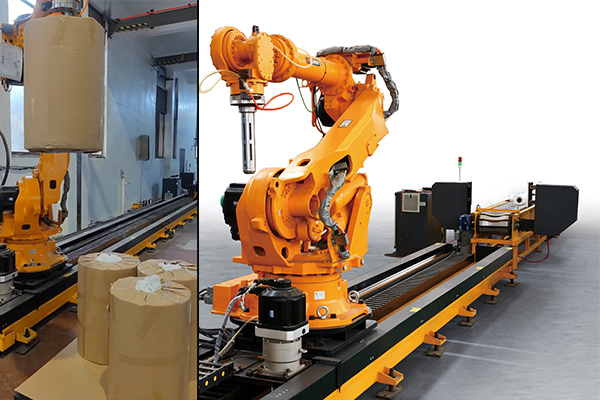
Modern Robotic Palletizing Systems are not only robot arms. A complete system usually includes the robot body, end gripper, conveyor interface, sensors, servo drive, control cabinet, and human-machine interface. These parts work together to identify products, move them safely, and stack them according to the required pallet pattern.
JINGWEI’s automated palletizing equipment is described as a system composed of a main robot arm, end gripper mechanism, conveyor line interface module, intelligent sensor system, servo drive mechanism, electronic control system, and human-machine interface. This matches the modern direction of palletizing, where mechanical movement, sensing, and digital control are combined into one end-of-line solution.
Why This History Matters For Film Manufacturing
For film production lines, palletizing history shows one clear trend: factories are moving from manual handling toward integrated automation. Finished products from casting, slitting, rewinding, inspection, lamination, or packaging areas need to be stacked with stable patterns and less product damage.
JINGWEI provides film machinery solutions covering cast film production lines, slitting and inspection rewinding machines, Printing equipment, lamination systems, winding upgrades, and palletizing robot arms. This process experience helps our team design palletizing solutions that connect with the real production workflow rather than working as an isolated machine.
Professional Advice For Project Planning
Before selecting Robotic Palletizing Systems, buyers should prepare finished product size, weight range, package type, conveyor height, line speed, pallet size, stacking pattern, workshop layout, and future product changes. The end gripper should match the real product, while the control logic should match upstream equipment and factory logistics.
Share your finished product information, output target, and layout requirements with JINGWEI. Our team can help recommend a practical robotic palletizing solution for stable production, easier handling, and long-term equipment planning.