


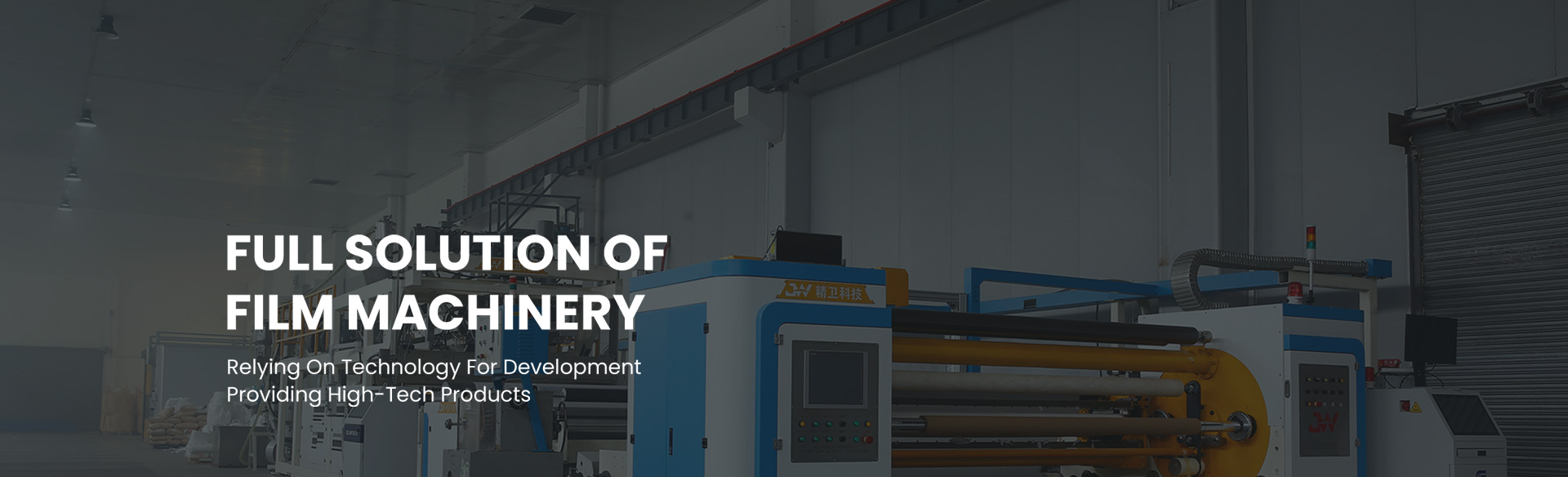
Quality Control Checkpoints in Continuous Film Extrusion Machines
For buyers sourcing continuous film extrusion machines, quality control starts long before the line is powered on. In real production, poor gauge stability, uneven cooling, die build up, winding defects, and weak documentation usually create bigger losses than the machine price itself. A stronger sourcing decision looks at the full system, from design and machining to testing, commissioning, and export readiness. JINGWEI operates as a direct equipment manufacturer rather than a trader, and its cast film production line business highlights integrated engineering across film processing, rewinding, lamination, and related automation. The company states that it was founded in 2017 and that its team has over 16 years of experience in hygiene machinery manufacturing.
Why Manufacturer Control Matters More Than Trading
In a manufacturer vs trader comparison, the key issue is process ownership. A manufacturer can control screw configuration, die flow path design, heating structure, tension architecture, machining accuracy, assembly sequence, and final test records. A trader may coordinate supply, but usually does not control the real engineering checkpoints. For OEM projects, that difference affects delivery consistency, spare parts response, technical modification speed, and long term line stability. JINGWEI positions itself around coordinated film processing equipment and complete production workflow support, which is far more relevant for project buyers than simple resale.
Core Quality Control Checkpoints In Manufacturing
The first checkpoint is component machining accuracy. Die head geometry, roll surface finish, shaft alignment, heater installation, and tension system precision directly affect film uniformity. The second checkpoint is electrical and thermal stability. LyondellBasell notes that in flat film extrusion, melt temperatures near the die can reach about 555°F or 290°C, and each heating zone should not vary by more than 2°F for stable operation. That makes heater zoning, sensor calibration, and control logic critical during machine build and factory testing.
The third checkpoint is online thickness control. ASTM D8136 covers plastic film thickness measurement from 2.5 to 250 μm using non contact capacitance technology and supports variability profiling in both machine and transverse directions. For many buyers, this is one of the most practical indicators when reviewing a project sourcing checklist because it shows whether the line can hold stable output during continuous production, not only during a short demo run.
The fourth checkpoint is finished film performance verification. ASTM D882 is used for tensile properties of thin plastic sheeting and films under 1.0 mm thickness, while ASTM D1003 covers haze and luminous transmittance for transparent plastics. These tests matter because a machine is not judged only by output speed. It is judged by whether the film reaches downstream converting and customer use standards with repeatable strength, clarity, and consistency.
Material Standards Used In Line Evaluation
A reliable manufacturing process overview also checks how the machine handles material variation. Resin grade, melt flow behavior, additive packages, and layer structure all influence output. During machine validation, the supplier should confirm material compatibility, screw suitability, die pressure stability, and cooling response under target resin conditions. On the quality management side, ISO 9001 requires organizations to establish, implement, maintain, and continually improve a quality management system, which is especially important in OEM and ODM equipment programs where drawings, change control, and inspection records must stay traceable.
| Checkpoint | What buyers should verify | Why it matters |
|---|---|---|
| Mechanical build | Die machining, roller balance, frame rigidity | Affects gauge stability and vibration |
| Thermal control | Heater zoning, sensor calibration, melt temperature consistency | Prevents thickness fluctuation |
| Online inspection | Thickness profiling and data logging | Confirms continuous process control |
| Film testing | Tensile strength, haze, transmittance | Verifies end product quality |
| Documentation | FAT records, drawings, spare parts list, manuals | Supports OEM delivery and after sales |
| Compliance | Electrical safety file and export documents | Reduces cross border project risk |
OEM ODM Process And Bulk Supply Considerations
For OEM / ODM process projects, the right supplier should offer more than standard machine configuration. Buyers should review drawing confirmation, sample specification lock, material trial plan, FAT protocol, packing standard, installation support, operator training, and spare parts planning. These are the real bulk supply considerations for equipment projects. When the supplier controls engineering internally, modification cycles are shorter and communication is clearer. That is one reason many buyers prefer a film extrusion line manufacturer over a trading company for long production programs.
Export Market Compliance Should Be Checked Early
For export market compliance, documentation should be reviewed before shipment, not after production. In the EU, machinery placed on the market must meet health and safety requirements under Directive 2006/42/EC, and the newer Machinery Regulation will apply from January 20, 2027. For project buyers, that means electrical drawings, safety logic, guarding, manuals, and technical files should be aligned early in the sourcing cycle. A supplier that understands export documentation usually reduces commissioning delays and customs risk.
Final Takeaway
When evaluating quality control checkpoints in continuous film extrusion equipment, the most important question is not only how fast the line runs. It is whether the supplier can prove control over machining, temperature, thickness, testing, documentation, and compliance. JINGWEI’s integrated equipment approach makes that manufacturer side value clearer for buyers comparing direct factories with intermediaries. In film projects where consistency decides margin, process control is the real product.