


PE Film Casting Machine vs Blown Film Machine: Which One Fits Your Production Needs?
Choosing the right film production equipment directly affects product quality, production efficiency, and long-term investment returns. Although Pe Film Casting Machines and blown film machines both process polyethylene materials, they use different production methods and create films with different performance characteristics.
The right choice depends on the target application, required film properties, production capacity, and future expansion plans. As a professional film machinery manufacturer, JINGWEI provides customized film production solutions, including PE film casting machines, Breathable Film Casting Machines, blown film machines, and complete film processing systems. (JINGWEI)
Basic Difference Between PE Film Casting Machine and Blown Film Machine
The main difference between these two technologies is the film forming process.
A PE film casting machine uses a flat die extrusion process. Molten polyethylene material passes through a precision T-die and is quickly cooled on a casting roller to form a flat film. This process provides excellent thickness control, smooth surface quality, and stable production performance.
A blown film machine uses an annular die to extrude molten plastic into a tube shape. Air is introduced into the tube to create a film bubble, which is cooled and stretched before being flattened and wound.
| Comparison | PE Film Casting Machine | Blown Film Machine |
|---|---|---|
| Film forming method | Flat die casting | Bubble inflation |
| Cooling method | Cooling roller | Air cooling ring |
| Thickness control | Higher precision | Depends on bubble stability |
| Film surface | Smoother | Slightly different texture |
| Film orientation | Mainly machine direction | Balanced biaxial orientation |
| Production advantage | Uniformity and efficiency | Flexibility and strength |
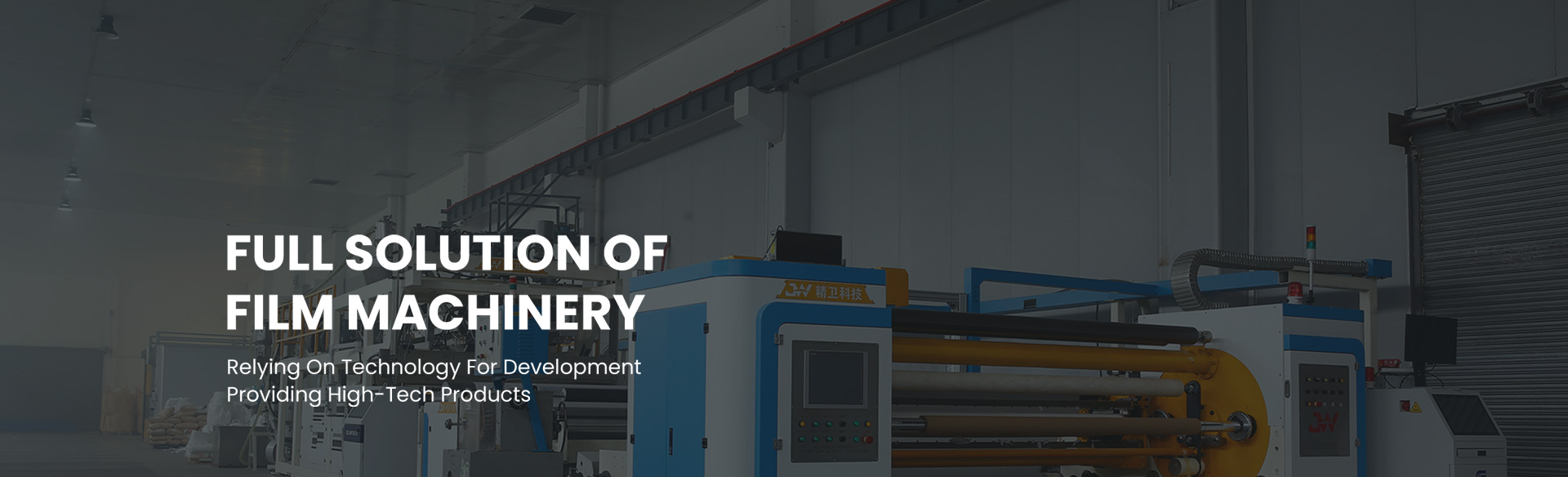
JINGWEI's PE Film Casting Machine is designed to cast polyethylene raw materials into thin films after heating and melting, commonly used in sanitary materials and packaging applications. (JINGWEI)
Different Applications Determine Equipment Selection
The biggest factor when selecting equipment is the final film application.
PE Film Casting Machine Applications
PE film casting technology is commonly used for:
Hygiene material films
Packaging films
Protective films
Laminating base films
Functional polyethylene films
For applications requiring stable thickness, smooth surfaces, and high production consistency, cast film technology provides strong advantages.
Blown Film Machine Applications
Blown film machines are widely used for:
Shopping bags
Packaging films
Agricultural films
Shrink films
Industrial protective films
Blown film technology is suitable for applications requiring good mechanical strength and flexible film structures.
Manufacturing Process Comparison
PE Film Casting Process
A typical PE film casting production process includes:
Raw material feeding
Extrusion melting
Melt filtration
T-die forming
Cooling roller shaping
Thickness adjustment
Film winding
The cooling roller plays an important role because rapid and uniform cooling directly affects film thickness and surface quality.
JINGWEI PE film casting solutions integrate extrusion systems, precision die heads, cooling roller groups, automatic winding systems, and optional digital production functions to improve production stability. (JINGWEI)
Blown Film Production Process
The blown film process includes:
Resin feeding
Plasticization and extrusion
Circular die forming
Bubble inflation
Air cooling
Bubble collapsing
Film winding
The stability of the film bubble is critical because variations in air pressure, cooling conditions, and material flow can influence film thickness.
Film Performance Comparison
Different production technologies create different film characteristics.
| Performance Factor | PE Film Casting Machine | Blown Film Machine |
|---|---|---|
| Thickness uniformity | Excellent | Good |
| Surface smoothness | Excellent | Good |
| Transparency | Higher | Depends on material |
| Mechanical strength | Stable | Strong biaxial properties |
| Production consistency | High | Requires process control |
Cast film production is generally preferred when manufacturers require precise thickness control and consistent surface quality. Blown film production provides advantages when balanced strength and flexible film structures are more important.
Material Standards and Processing Requirements
Material selection directly affects machine performance.
PE film casting machines commonly process:
LDPE
LLDPE
HDPE
Functional PE materials
The production process requires accurate control of:
Melt temperature
Material mixing
Extrusion pressure
Cooling conditions
Film thickness
For blown film machines, manufacturers need to consider:
Resin flow characteristics
Bubble stability
Cooling efficiency
Film stretching ratio
A professional machinery manufacturer should evaluate both the material properties and final application before recommending equipment.
Production Efficiency and Automation Comparison
Modern film production requires not only stable output but also intelligent control systems.
| Factor | PE Film Casting Machine | Blown Film Machine |
|---|---|---|
| Automation level | High | High |
| Thickness monitoring | Easy integration | Requires bubble monitoring |
| Production data management | Available | Available |
| Labor efficiency | High | High |
JINGWEI integrates digital production solutions, including MES production management systems, online inspection systems, and remote diagnosis capabilities to improve equipment management and production transparency. (JINGWEI)
Quality Control Checkpoints
Film quality depends on precise control throughout the manufacturing process.
Important quality checkpoints include:
| Quality Control Point | Purpose |
|---|---|
| Raw material inspection | Ensure material consistency |
| Temperature control | Maintain stable melting |
| Thickness measurement | Control film uniformity |
| Surface inspection | Detect defects |
| Winding inspection | Improve roll quality |
For PE film production, thickness accuracy and surface quality are key evaluation points. For blown film production, bubble stability and film orientation require additional attention.
Manufacturer vs Trader: Why Technical Support Matters
A film production line is a long-term industrial investment. Choosing a manufacturer with engineering capability provides advantages over purchasing from a general equipment supplier.
A professional manufacturer can provide:
Production line design
Equipment configuration recommendations
Technical support
Installation guidance
Process optimization
Maintenance service
JINGWEI focuses on complete film machinery solutions and provides customized equipment according to different production requirements. The company has more than 16 years of experience in hygiene machinery manufacturing and has developed multiple patented technologies and ISO9001-certified production systems. (JINGWEI)
OEM and Customized Film Machinery Process
Different manufacturers may have different production goals. Customized machinery development usually includes:
Production requirement analysis
Film application evaluation
Equipment configuration design
Manufacturing and assembly
Factory testing
Installation and commissioning
Customization options may include:
Film width
Production speed
Automation level
Downstream equipment integration
Online inspection systems
Bulk Supply and Project Sourcing Checklist
Before investing in a PE film casting machine or blown film machine, manufacturers should evaluate:
| Evaluation Item | Key Question |
|---|---|
| Final product | What type of film will be produced? |
| Material requirement | Which PE materials are needed? |
| Production capacity | What output is required? |
| Quality standard | What film performance is expected? |
| Automation demand | How much labor reduction is needed? |
| Future expansion | Can the line support upgrades? |
Which Machine Fits Your Production Needs?
A PE film casting machine and a blown film machine are designed for different production goals.
A PE film casting machine is suitable for manufacturers requiring:
High thickness accuracy
Smooth film surfaces
Stable production efficiency
Consistent film quality
A blown film machine is suitable for manufacturers requiring:
Strong mechanical performance
Flexible film structures
Wider material adaptability
The best equipment choice depends on the final product requirements, production strategy, and future business development.
JINGWEI provides professional film machinery solutions with customized engineering, intelligent production systems, and complete project support. From PE film casting machines and breathable film casting machines to integrated film production lines, JINGWEI helps manufacturers build efficient and reliable film production capabilities. (JINGWEI)